Manual Lathes: A Comprehensive Guide
Manual lathes, essential machining tools, shape materials through controlled cutting; resources like the Internet Archive offer valuable manuals for models like Hardinge and Atlas.
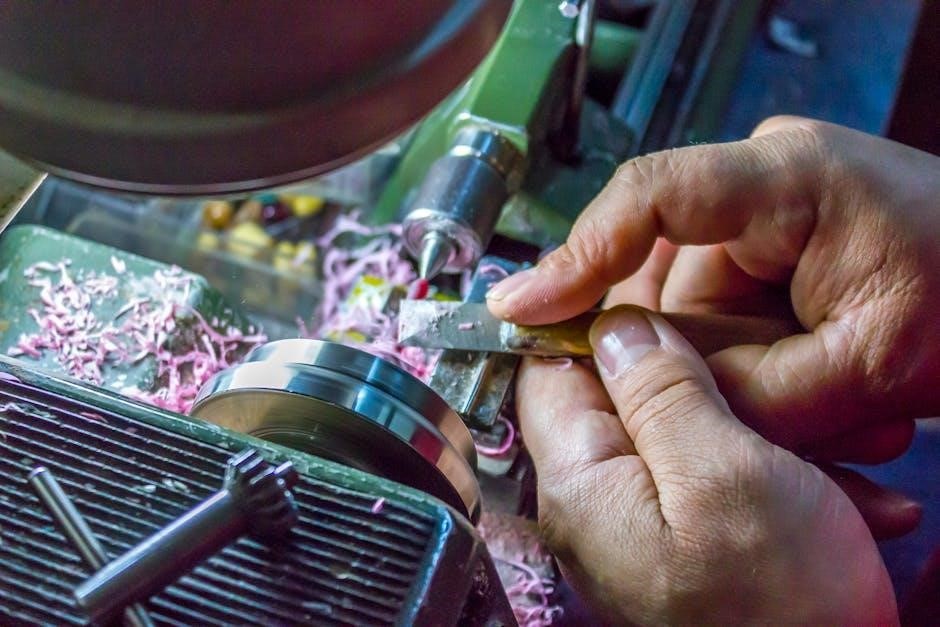
Manual lathes represent a cornerstone of machining, utilizing a rotating workpiece and a stationary cutting tool to create cylindrical shapes. Unlike their computerized counterparts, these machines demand direct operator control, fostering a deep understanding of material properties and cutting techniques. The core principle involves securing a workpiece in a chuck or between centers, then employing various tools to remove material.
Historically significant, manual lathes paved the way for modern manufacturing. They remain invaluable for small-scale production, prototyping, and repair work. Resources like readily available manuals – including those from Hardinge and Atlas Press Co. – are crucial for operation and maintenance. Understanding the fundamental operations – turning, facing, drilling, and threading – is key to mastering this versatile machine.
Historical Development of Manual Lathes
Manual lathes trace their origins back to ancient times, evolving from simple pole lathes used for woodworking. The 18th and 19th centuries witnessed significant advancements with the introduction of screw-cutting lathes, driven by water or steam power. These early machines were pivotal in the Industrial Revolution, enabling mass production of standardized parts.
The development of the engine lathe, replacing the pole lathe, marked a turning point. Later, turret lathes emerged, enhancing efficiency by allowing multiple tools to be fitted, minimizing setup time. Companies like Hardinge and Atlas Press Co. became prominent manufacturers, providing robust and reliable machines. Access to historical documentation, including archived manuals, reveals the gradual refinement of lathe design and functionality, shaping modern machining practices.
Types of Manual Lathes
Manual lathes come in several distinct types, each suited for specific machining tasks. The Engine Lathe, a general-purpose machine, is characterized by its tailstock, allowing for versatile operations. In contrast, the Turret Lathe features a hexagonal turret holding multiple tools, ideal for repetitive work and minimizing setup changes – a key advantage for producing identical parts efficiently.
The Toolroom Lathe prioritizes precision and is often used for creating tools and dies. Finally, Special Purpose Lathes are designed for highly specific applications, like crankshaft machining. Understanding these variations is crucial for selecting the appropriate lathe for a given project, maximizing productivity and achieving desired results.
Engine Lathe
The Engine Lathe represents the foundational design in manual lathe technology, serving as a versatile workhorse for a broad spectrum of machining operations. Its defining characteristic is the presence of a tailstock, providing support for longer workpieces during processes like turning, facing, and drilling. This configuration allows for exceptional control and accuracy.
Engine lathes are adaptable, capable of handling diverse materials and part sizes. They are frequently employed in general machining tasks, toolmaking, and repair work. The ability to easily change tools and adjust settings makes them ideal for both one-off projects and small production runs. Their robust construction ensures longevity and reliable performance.
Turret Lathe
The Turret Lathe distinguishes itself through a hexagonal turret replacing the traditional tailstock of an engine lathe. This innovative design allows for mounting multiple tools directly onto the turret face, enabling sequential operations without workpiece or tool resetting. This dramatically increases efficiency, particularly in repetitive manufacturing scenarios.
Consequently, turret lathes excel at producing identical parts quickly and accurately. They are ideally suited for tasks requiring a series of operations – such as turning, facing, drilling, and threading – to be performed in a predetermined order. This minimizes handling time and maximizes throughput, making them a staple in production environments where speed and consistency are paramount.
Toolroom Lathe
Toolroom Lathes represent a pinnacle of precision within the manual lathe family, designed for creating tools, dies, and fixtures – hence the name. These machines prioritize accuracy and versatility over sheer production speed. They typically feature a higher degree of rigidity and finer control mechanisms compared to standard engine lathes.
Toolroom lathes often incorporate features like a more robust spindle, improved lead screw accuracy, and enhanced carriage rigidity. This allows for extremely precise cuts and intricate work. They are frequently used for one-off projects, prototypes, and repair work where exacting tolerances are critical. Access to detailed manuals, like those available through the Internet Archive for Hardinge models, is crucial for optimal operation and maintenance.
Special Purpose Lathes
Special Purpose Lathes deviate from general-purpose designs, optimized for specific tasks or materials. These machines often incorporate unique features tailored to streamline particular manufacturing processes. Examples include crankshaft lathes, camshaft lathes, and lathes designed for working with specific materials like plastics or non-ferrous metals.
Unlike engine, turret, or toolroom lathes, special purpose machines prioritize efficiency within a narrow application. They may feature automated features, specialized tooling, or modified geometries to enhance performance for their intended function. Finding detailed documentation for these specialized machines can be challenging, but resources like Vintage Machinery and the Internet Archive may hold valuable information, potentially including Hardinge brochures or related manuals, aiding in operation and repair.
Key Components of a Manual Lathe
Essential components include the bed, headstock, tailstock, and carriage with its cross and compound slides, enabling precise material shaping and control.
Bed
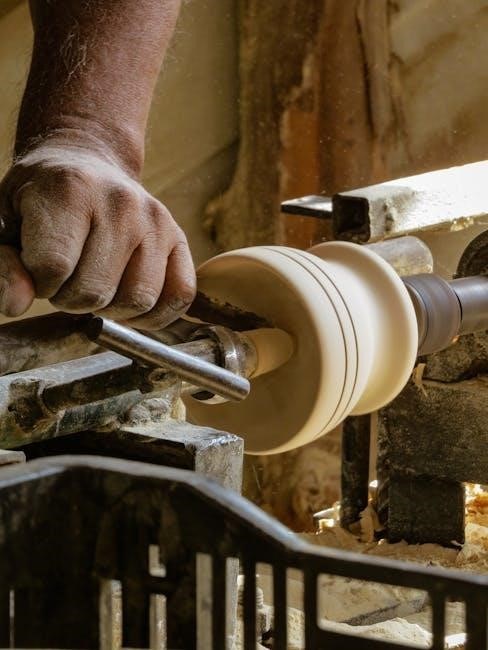
The lathe bed serves as the foundational element, providing a rigid base for all other components. Typically constructed from cast iron, it’s designed to withstand significant forces generated during machining operations. Its substantial mass contributes to vibration damping, crucial for achieving accurate cuts and surface finishes.
Longitudinal ribs are often incorporated into the bed’s structure to enhance its strength and rigidity. These ribs resist deflection under load, maintaining alignment between the headstock, tailstock, and carriage. The bed features precisely machined ways – hardened and ground surfaces – that guide the movement of the carriage and tailstock.
These ways ensure smooth, accurate travel along the lathe’s length. Proper lubrication of the ways is essential to minimize friction and wear, preserving the bed’s accuracy over time. The bed’s design directly impacts the overall precision and capability of the manual lathe.
Headstock
The headstock is a critical component housing the main spindle and drive mechanism of a manual lathe. It’s responsible for transmitting power to the spindle, rotating the workpiece at various speeds. Within the headstock, a series of gears allows for adjustments to the spindle speed, accommodating different materials and machining operations.
These gears are often arranged in a gear train, providing a range of speed options. The spindle itself is typically supported by high-quality bearings, ensuring smooth and accurate rotation. A back gear mechanism may be included to provide lower speeds with increased torque, beneficial for heavy cuts.
The headstock’s robust construction and precise machining are vital for maintaining spindle alignment and minimizing vibration, directly impacting the quality of the finished workpiece.
Tailstock
The tailstock, positioned opposite the headstock on a manual lathe, provides support for the workpiece, especially during longer turning operations. Its primary function is to maintain alignment and prevent deflection of the material being machined. The tailstock features a quill, a cylindrical housing that extends and retracts, allowing it to be adjusted to support the workpiece at different lengths.
Within the quill resides a spindle, often fitted with a center, which provides the actual support. The tailstock can be precisely positioned along the lathe bed and locked into place.
Importantly, in turret lathes, the tailstock is replaced by a hexagonal turret, enabling multiple tools to be fitted for sequential operations, increasing efficiency.
Carriage
The carriage is a crucial component of a manual lathe, mounted on the lathe bed and responsible for supporting and moving the cutting tool. It facilitates precise control over the depth of cut and the overall movement along the workpiece. The carriage houses two primary slides: the cross slide and the compound slide, enabling complex machining operations.

Movement along the lathe bed is typically achieved via a leadscrew and handwheel, allowing for controlled feed rates. The carriage’s rigidity and smooth movement are vital for achieving accurate and consistent results.
Proper lubrication and maintenance of the carriage’s ways are essential for optimal performance and longevity.
Cross Slide
The cross slide, mounted on the carriage of a manual lathe, provides movement perpendicular to the lathe’s spindle axis. This allows the operator to control the depth of cut, enabling precise facing, turning, and boring operations. It’s typically moved using a handwheel, offering fine control over the tool’s position.
The cross slide often features a dovetail construction, ensuring rigidity and minimizing backlash. It supports the compound slide, further enhancing machining capabilities. Accurate adjustment of the cross slide is fundamental for achieving desired dimensions and surface finishes.
Regular cleaning and lubrication are vital for smooth operation and maintaining precision.
Compound Slide
The compound slide, positioned atop the cross slide on a manual lathe, introduces two axes of movement – one parallel to the spindle and another perpendicular, offering exceptional versatility. This allows for complex operations like taper turning, angled cuts, and creating curved surfaces with remarkable precision.
It’s equipped with graduated dials for accurate positioning along both axes, enabling the machinist to control feed rates and cutting depths meticulously. The compound slide’s ability to swivel is crucial for machining conical shapes without stopping the lathe.
Maintaining its alignment and cleanliness is essential for consistent, high-quality results.
Lathe Operations
Manual lathe operations encompass turning, facing, drilling, boring, threading, and knurling—essential techniques for shaping materials with precision and control.
Turning
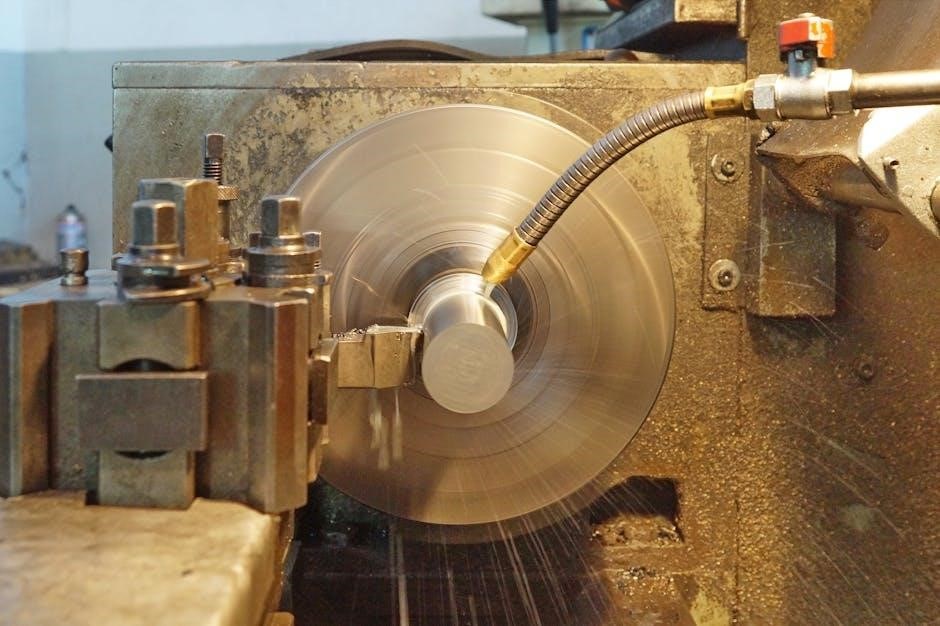
Turning on a manual lathe is a fundamental operation, reducing a workpiece’s diameter by removing material along its length. The process involves securing the material in the chuck or between centers, then utilizing a single-point cutting tool to shear away excess material as the workpiece rotates.
Different turning operations exist, including straight turning for a consistent diameter, taper turning for a conical shape achieved by either setting the compound rest at an angle or using a taper attachment, and profile turning to create complex contours. Proper tool selection, cutting speed, and feed rate are crucial for achieving a smooth finish and accurate dimensions. Skilled operators carefully control these parameters, observing the chip formation to ensure efficient material removal and prevent tool chatter. Turning forms the basis for many other lathe operations, establishing the initial shape before further machining.
Facing
Facing on a manual lathe creates a flat, perpendicular surface on the end of a workpiece. This operation is essential for establishing a reference plane and ensuring accurate subsequent machining. The process utilizes a cutting tool moved radially across the rotating workpiece, removing material until the desired face is achieved.
Facing can be performed using various tool shapes and angles, depending on the material and desired finish. Operators carefully adjust the carriage and cross slide to control the depth of cut and ensure a smooth, even surface. Like turning, proper cutting speed and feed rate are vital. Achieving a perfectly flat face requires precision and attention to detail, often involving multiple passes with progressively lighter cuts. Facing prepares the workpiece for further operations like drilling or threading, guaranteeing alignment and stability.
Drilling
Drilling on a manual lathe allows for creating precise, cylindrical holes in rotating workpieces. Unlike dedicated drill presses, lathe drilling leverages the workpiece’s rotation for consistent hole creation. The tailstock, securely positioned, houses and guides the drill bit, providing stability and accuracy during the process.
Operators carefully select drill bit sizes and cutting speeds based on the material being drilled. Applying cutting fluid is crucial for lubrication and heat dissipation, extending tool life and improving hole quality. The carriage is advanced to feed the drill bit into the workpiece, controlling the depth and rate of penetration. Precise control over these parameters prevents breakage and ensures a clean, accurate hole. Lathe drilling is often used for creating pilot holes before larger boring operations.
Boring
Boring on a manual lathe expands existing holes to a precise diameter, offering greater accuracy than initial drilling. This operation utilizes single-point cutting tools mounted on the carriage, moving linearly while the workpiece rotates. Unlike drilling, boring refines an already existing hole, correcting imperfections or achieving a specific fit.
The lathe’s carriage movements, combined with careful tool selection and speed adjustments, are critical for achieving desired results. Boring bars, extending from the tool post, allow for reaching deeper into the workpiece. Coolant application remains essential for heat management and tool longevity. Boring is frequently employed after drilling to achieve final dimensions and surface finishes, ensuring a smooth, accurate cylindrical form. It’s a vital step in precision machining.
Threading
Threading on a manual lathe creates helical ridges – threads – on cylindrical workpieces, essential for fasteners and assemblies. This process utilizes a specialized threading tool, angled to match the desired thread pitch, and relies on precise carriage movements synchronized with the spindle rotation.
The half-nut mechanism engages the lead screw, controlling the carriage’s longitudinal feed rate per spindle revolution. Selecting the correct gear ratio is crucial for achieving the intended thread pitch. Multiple passes are often required, gradually deepening the thread form. Proper tool geometry, cutting speed, and coolant application are vital for clean, accurate threads. Internal and external threads can be cut, demanding different tool angles and approaches. Mastering threading requires practice and careful attention to detail.
Knurling
Knurling on a manual lathe is a forming process, not a cutting one, creating a textured surface – a pattern of raised diamonds or straight lines – for improved grip. Specialized knurling tools, with hardened steel rollers, are pressed into the rotating workpiece, displacing material to form the desired pattern.

This process enhances the ability to firmly grasp objects, crucial for knobs, handles, and other components requiring manual manipulation. Proper workpiece material and speed are essential; softer materials knurl more easily. Applying cutting fluid helps lubricate and cool the process. Different knurling wheel patterns produce varied textures. It’s important to note that knurling slightly reduces the workpiece diameter. Careful setup and consistent pressure are key to achieving a uniform, aesthetically pleasing knurled surface.

Manuals and Resources
Essential resources include the Internet Archive for Hardinge and Atlas lathe manuals, alongside Vintage Machinery, offering reprints and valuable machinist information.
Hardinge Lathe Manuals (Availability)
Hardinge lathe manuals, highly sought after by machinists and vintage machinery enthusiasts, are becoming increasingly accessible thanks to digitization efforts. The Internet Archive hosts a substantial collection, including operator manuals, parts lists, and brochures for models like the HLV-H and HLVU.
Available downloads include zipped files containing JP2 images of manuals, ranging in size from approximately 5.8MB to 67.4MB. These resources cover various aspects of Hardinge lathes, from basic operation and maintenance to detailed parts breakdowns and historical specifications dating back to 1968.
Furthermore, information regarding pneumatic spindle collet closers is also available. These digital archives provide invaluable support for those restoring, repairing, or simply learning about these precision machines, ensuring their continued use and preservation.
Atlas Press Co. Manuals
Atlas Press Co. historically provided comprehensive manuals for their lathe operations, and reprints of these valuable resources are now available. The “Manual of Lathe Operation” offered by Atlas Press Co. served as a foundational guide for machinists learning the intricacies of lathe work.
These manuals, often referred to as Machinists Tables (MOLO), represent the 23rd edition and detail essential techniques and procedures. Accessing these resources is facilitated through platforms like VintageMachinery.org, a website dedicated to preserving information about classic industrial equipment.
While VintageMachinery.org operates on donations, it provides a crucial service by hosting and distributing these historical documents. Supporting their efforts ensures continued access to vital knowledge for lathe enthusiasts and professionals alike, preserving a legacy of machining expertise.
Vintage Machinery Resources
VintageMachinery.org stands as a pivotal online resource for those interested in manual lathes and their associated documentation. The website diligently collects and provides access to a wealth of information pertaining to older machine tools, including lathes from various manufacturers.
Recognizing the cost associated with maintaining such a comprehensive archive, VintageMachinery.org relies on voluntary donations to offset expenses. These contributions directly support the preservation and dissemination of valuable historical data for machinists and hobbyists.
The platform’s dedication ensures that knowledge surrounding classic lathe operation, maintenance, and repair remains accessible. By supporting VintageMachinery.org, users contribute to the ongoing preservation of machining heritage and the availability of crucial resources for future generations of lathe operators.
Internet Archive Resources for Lathe Manuals
The Internet Archive provides a substantial digital library containing numerous lathe manuals available for free download, borrowing, and streaming. Specifically, a significant collection of Hardinge lathe documentation is accessible, including operator manuals, parts lists, and brochures dating back to 1968.
Available resources encompass files like the Hardinge HLV-H Operator Manual (44.9M), Hardinge HLV-H Parts List (5.8M), and maintenance manuals (67.4M) in JP2 format. These digitized materials offer invaluable assistance for operating, repairing, and understanding vintage manual lathes.
The archive’s breadth extends beyond Hardinge, offering a pathway to locate manuals for other lathe models, facilitating restoration and continued use of these essential machining tools. It’s a crucial resource for enthusiasts and professionals alike.

Safety Precautions
Prioritize safety when operating manual lathes; always utilize appropriate Personal Protective Equipment (PPE) and adhere to established safe operating procedures.
Personal Protective Equipment (PPE)

Operating a manual lathe demands strict adherence to safety protocols, beginning with appropriate Personal Protective Equipment (PPE). Eye protection is paramount; safety glasses or a face shield are crucial to deflect flying chips generated during machining operations. These particles, often ejected at high velocity, pose a significant risk of eye injury.
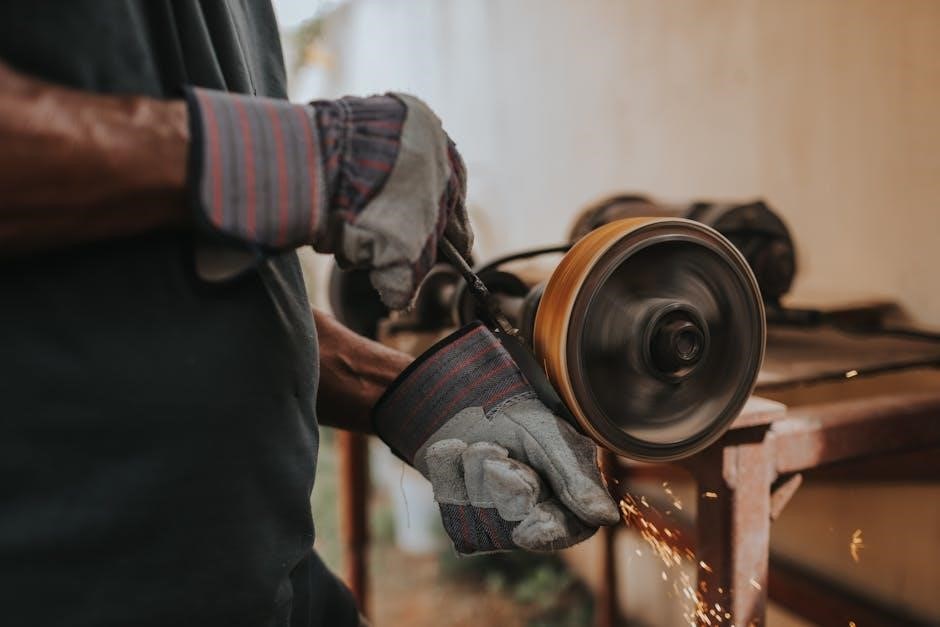
Furthermore, sturdy footwear is essential to protect feet from dropped tools or materials. Avoid wearing loose clothing or jewelry that could become entangled in the lathe’s moving parts. Gloves, while sometimes used, require careful consideration as they can potentially be drawn into the machinery.
Hearing protection may be necessary in noisy environments. A shop coat or apron provides an additional layer of protection against coolant and metal fragments. Consistent use of these PPE items significantly minimizes the risk of accidents and injuries while working with a manual lathe.
Safe Operating Procedures
Prioritizing safe operating procedures is fundamental when utilizing a manual lathe. Before commencing any operation, thoroughly inspect the machine for any damage or loose components. Securely fasten the workpiece in the chuck or between centers, ensuring it’s properly aligned. Always use appropriate cutting tools, sharpened correctly for the material being machined.
Never reach over a rotating lathe; always stop the machine before making adjustments or measurements. Keep hands and tools clear of the cutting area. Utilize the provided guards and shields, and never remove them.
Maintain a clean and organized workspace, free from obstructions. Proper coolant application is vital for both tool life and chip removal. Adhering to these procedures minimizes risks and promotes a safe working environment when operating a manual lathe.